How Does VXX Work?

Wednesday, April 24th, 2013 | Vance Harwood
 

VXX and its sister fund VXZ were the first Exchange Traded Notes (ETNs) available for volatility trading in the USA.  To have a good understanding of how Barclays Bank PLC iPath S&P 500 VIX Short-Term Futures ETN works you need to know how it trades, how its value is established, what it tracks, and how Barclays makes money running it.

How does VXX trade? 

  • For the most part VXX trades like a stock.  It can be bought, sold, or sold short anytime the market is open, including pre-market and after-market time periods.  With an average daily volume of 50 million shares its liquidity is excellent and the bid/ask spreads are a penny.
  •  It has a very active set of options available, with five weeks’ worth of Weeklys and close to the money strikes every 0.5 points.
  • Like a stock, VXX’s shares can be split or reverse split— 4:1 reverse-splits are the norm and can occur once VXX closes below $25.
  • VXX can be traded in most IRAs / Roth IRAs, although your broker will likely require you to electronically sign a waiver that documents the various risks with this security.   Shorting of any security is not allowed in an IRA.

How is VXX’s value established?

  • Unlike stocks, owning VXX does not give you a share of a corporation.  There are no sales, no quarterly reports, no profit/loss, no PE ratio, and no prospect of ever getting dividends.  Forget about doing fundamental style analysis on VXX.
  • The value of VXX is set by the market, but it’s closely tied to the current value of an index (S&P VIX Short-Term Futurestm) that manages a hypothetical portfolio of the two nearest to expiration VIX futures contracts.  Every day the index specifies a new mix of VIX futures in that portfolio.  For more information on how the index itself works see this post or the VXX prospectus.
  • The index is maintained by the S&P Dow Jones Indices and the current value of VXX if it were perfectly tracking the index is published every 15 seconds as the “intraday indicative” (IV) value.  Yahoo Finance publishes this quote using the ^VXX_IV ticker.
  • Wholesalers called “Authorized Participants” (APs) will at times intervene in the market if the trading value of VXX diverges too much from the IV value.  If VXX is trading enough below the index they start buying large blocks of VXX—which tends to drive the price up, and if it’s trading above they will short VXX.  The APs have an agreement with Barclays that allows them to do these restorative maneuvers at a profit, so they are highly motivated to keep VXX’s tracking in good shape.

What does VXX track?

  • Ideally VXX would track the CBOE’s VIX® index—the market’s de facto volatility indicator.  However since there are no investments available that directly track the VIX Barclays chose to track the next best choice: VIX futures.
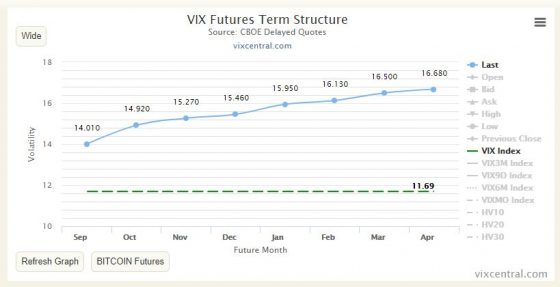
  • Unfortunately using VIX futures introduces a host of problems. The worst is horrific value decay over time.  Most days both sets of VIX futures that VXX tracks drift lower relative to the VIX—dragging down VXX’s value at the average rate of 5% to 10% per month.  This drag is called roll or contango loss.
  • Another problem is that the combination of VIX futures that VXX tracks does not follow the VIX index particularly well.  On average VXX moves only 55% as much as the VIX index.
  • Most people invest in VXX as a contrarian investment, expecting it to go up when the equities market goes down.  It does a respectable job with the VXX averaging percentage moves -2.94 times the S&P 500, but 16% of the time VXX has moved in the same direction as the S&P 500.  The distribution is shown below:

VXX% moves / SPX% moves

VXX% moves / SPX% moves (SPX daily moves of less than +/-0.1% are excluded)


  • With lethargic tracking to the VIX, erratic tracking with the S&P 500 and heavy price erosion over time, owning VXX is usually a poor investment. Unless your timing is especially good you will lose money.

How does Barclays make money on VXX?

  • Barclays collects a daily investor fee on VXX’s assets—on an annualized basis it adds up to 0.89% per year.  With current assets at $1.15 billion this fee totals around $10 million per year.  That’s certainly enough to cover Barclays’ VXX costs and be profitable.  But even if it was all profit it would be a tiny 0.1% percent of Barclays’ overall net income— which was $10.5 billion in 2012.
  • From a public relations standpoint VXX is a disaster.  It’s frequently vilified by industry analysts and resides on multiple Worst ETF Ever lists.  You’d think Barclays would terminate a headache like this or let it fade away, but they haven’t done that even though 2 reverse splits—which suggests that Barclays is making more than $10 million a year with the fund.
  • Unlike an Exchange Trade Fund (ETF), VXX’s Exchange Traded Note structure does not require Barclays to specify what they are doing with the cash it receives for creating shares.  The note is carried as senior debt on Barclays’ balance sheet but they don’t pay out any interest on this debt.  Instead they promise to redeem shares that the APs return to them based on the value of VXX’s index—an index that’s headed for zero.
  • If Barclays wanted to fully hedge their liabilities they could hold VIX futures in the amounts specified by the index, but they almost certainly don’t because there are cheaper ways (e.g., swaps) to accomplish that hedge.  If fact it seems likely Barclays might assume some risk and not fully hedge their VXX position. According to IndexUniverse’s ETF Fund Flows tool, VXX’s net inflows have been $5.99 billion since inception in 2009—and it is currently worth $1.15 billion.  So $4.8 billion dollars has been lost by investors and an equivalent amount by Barclays if they were hedged at 100%.   If they were hedged at say 90% they would have cleared a cool $480 million over the last 4 years in addition to their investor fees.  Barclay’s affection for VXX might be understandable after all.

VXX is a dangerous chimeric creature; it’s structured like a bond, trades like a stock, follows VIX futures, and decays like an option.  Handle with care.

VXX Backtest 2004-2013

VXX Backtest 2004-2013


When You Think Your Exchange Traded Fund is Broken…

Sunday, March 17th, 2013 | Vance Harwood
 

When you thing your ETF/ETN is broken...
Frequently I see people complaining that their Exchange Traded Fund (ETF) or Exchange Traded Note (ETN) is broken. Occasionally they’re right, but most of the time they’re not.  Before complaining, here are some things to look at:

  1. Are you looking at the right index?
    • All Exchange Traded Products (ETPs) track an index, which is identified in their prospectus, and in the fund’s fact sheet.   Don’t assume what the index is.  For example, the index that VXX tracks is not the CBOE’s VIX® , and UVXY the 2X volatility fund is not designed to track 2X the VIX.
    • None of the volatility funds track the VIX, they all use other indexes, because the VIX itself is not investable.  Some funds (e.g., UVXY, CVOL) do a semi-decent job of tracking the VIX in the short term, but nobody does a good job in the medium to long run.  In fact it’s a killing field.
    • Investigate the index once you’ve determined what it is.  It’s often not easy; sometimes even getting quotes on indexes is hard.  But similar to the hunter’s credo of eating what they kill, investors should understand what they trade.
  2. Is the fund leveraged/geared (e.g., 2X, 3X), or an inverse fund?
    • Leveraged or inverse funds typically do a good job of delivering their target performance on a daily basis, but usually fall far short with longer time frames.  The reason is compounding error, or path dependency.  It erodes the value of these funds in choppy markets.
    • For example if a non-leveraged fund (e.g., SPY) goes up 10% one day and down 9.09% the next it ends up even.   However the 2X fund (SSO) and the inverse fund (SH) both end up down 1.8%
      • 2X Fund: (10*(2*10%)=12, 12*(2*-9.09%) = 9.82
      • -1X Fund: (10* (-10%) =9,  9 *(+9.09%) = 9.82
  3. What are the timestamps of the quotes you are looking at?
    • Unless your fund is very active the quote you’re using might be older than you think.  For example the fund’s closing value might reflect a trade that happened hours before market close.  If you look at an intra-day chart of your fund including volume you should be able to see when the trades occurred and the quotes updated.  Typically the intraday indicative value (“IV”) quote is a more accurate way of getting the actual fund value. It’s updated every 15 seconds during market hours.
    • The IV quote tickers are not standardized.  Yahoo finance uses a “^” prefix and a “_IV” suffix to get the IV value (e.g., ^VXX_IV).  For more on IV quote symbols see Trading ETFs Without Getting Fleeced.
  4. Are the markets you’re comparing closing at the same time?
    • VIX futures markets at the CBOE Futures exchange trade for 15 minutes after the equities markets close.   The volatility ETPs are based on volatility indexes that are based on futures settlement values.  Eli from VIX Central points out that these settlement values can come out well after 4:15.  The final IV update for the day appears to reflect these late settlements—giving us the real closing value for the volatility funds.
  5. Is the trading value of the funds diverging significantly from its index or IV value?
    • If this is the case, your fund might be broken, but before we pursue that there are a couple thing to check:
      • Are the markets for the underlying assets closed (e.g., Asian or European stocks)?  If so those indexes can’t update so some divergence during USA trading hours should be expected.
      • Are the securities for the underlying assets illiquid or rarely traded (e.g., high yield corporate bonds)?  If so the trading value might reflect the market’s estimation of what those assets are worth, rather than the last trade, or published bid/ask quotations.

If you’ve checked through all the items above and things still look wrong your fund may indeed be broken.  Historically the only pathology for ETF/ETNs is to have their share creation process halted or somehow limited.  Some of the stated reasons for doing this are:

  1. Market closures (e.g., the Egyptian stock market closed for 2 months in 2011: EGPT, )
  2. Regulatory hurdles, where permission to issue new shares is delayed UNG, UNL, DNO
  3. Issuer “internal limits on the size of ETNs”, TVIX
  4. Commodity  position limits, where the exchanges won’t allow the funds to accumulate more contracts UNG
  5. Self-imposed market cap limits AMJ

In all these cases the share redemption process has been left intact.  In practice if share creation is stopped and redemption is working the ETP’s price can rise higher than the index, but not drop significantly lower than the index.   Both UNG and TVIX were expensive object lessons for the people that didn’t understand this.

NYSE EURONEXT has a good webpage that lists all the funds that currently have suspended or put limits on share creation.

Credit Suisse’s TVIX has restarted limited share creation processes, but its requirements are so expensive the market makers still allow the fund to climb as much as 15% higher than its IV value—I consider that broken.


Barclays’ VXX—Not as Short Term as You Think

Thursday, June 28th, 2012 | Vance Harwood
 

In terms of assets Barclays’ “S&P 500 VIX Short-Term Futures” ETN is the leader in volatility ETFs currently with $1.6 billion under management.   I suspect it’s also one of the leaders in investor confusion.

Although VIX is in its formal name VXX doesn’t actually track the CBOE’s VIX index with any degree of precision. In fact it’s not unusual for VXX and VIX to move in opposite directions for a day or two.  VXX can’t directly follow the VIX index, because nobody has figured out a way to cost effectively make a market in the VIX index.  The best that can be done is to invest in VIX futures—which tend to have a mind of their own.

VIX futures come in monthly series that expire the 3rd or 4th Wednesday morning of each month.  The next VIX future series to expire is called the first or near month and its settlement value is determined by a special calculation that closely corresponds to the opening quote of the VIX index on expiration day.   This is the only linkage between all the various series of VIX futures to the VIX index—a once a month synchronization point with the just expired future.  It’s much worse than a stopped clock—which is right twice a day.

Just holding contracts for one futures expiration month at a time would give VXX a variable maturity.  To provide a constant maturity Barclays executes a daily roll of first and second month contracts, gradually reducing the number of first month contracts until they are all sold right before they expire.  Barclays describes this process as providing a “constant weighted average maturity of one month.”

This is really misleading.

The VIX index tracks “the market’s expectation of 30-day volatility.”  It computes this using a weighted mix of options that are at least 7 days from expiration plus longer dated options.

When the near month VIX futures contract expires it closely matches the VIX index value—the 30 day estimate.  But on that day VXX has 100% rolled over to the successor VIX futures contracts that have another 30 calendar days before they expire—so VXX is really providing a weighted maturity volatility expectation of 60 days, not 30.

A longer effective maturity would at least partially explain VXX’s tendency to move about 50% of the VIX index daily moves on average. Longer term volatility expectations are less volatile.

To verify this analysis I created a spreadsheet that computes average maturity for VIX futures using linear interpolation/extrapolation of the futures prices.   Since this does not require modeling the buying / selling of VIX futures contracts there are no distortions due to contract rolls.

The chart below shows the historical volatility (22 trading days) of the VIX index compared to the historical volatility of VXX and my synthesized mix of first and second month (M1/M2) VIX futures that I believe corresponds to a 60 day expectation of volatility.

VIX, VXX, and 60 day M1/M2


My synthesized values match up well with VXX’s actuals.  It is interesting that VXX’s huge yield roll costs don’t show up in this chart.   The average of VXX’s historical volatility since January 2009 has been 58%—compared to 102% for VIX.

Next I shifted my synthesized mix of M1/M2 futures to closely match the true 30 day expectation of VIX.

VIX, VXX, M1/M2 for 30 day estimation of volatility


My simulation uses a linear extrapolation of the VIX term structure, rather than an exponential match, so I expected extreme volatility events to be understated.  But in quiet times the match between the VIX index and my true 30 day maturity mix of VIX futures is often quite good.

I think Barclays’ stated “constant weighted average maturity of one month” is a month shy of reality, and I’d like to see that changed in their literature.  This product is confusing enough without misstating the duration of its volatility expectation by a factor of two.


VXX prospectus

Monday, February 13th, 2012 | Vance Harwood
 

You can find Barclays’ VXX prospectus here.  The prospectus covers both the short term VXX, and the medium term VXZ.

This post discusses going long on VXX.

This post discusses some choices if you think VXX is going to go down.

For a full list of volatility ETN/ETFs see Volatility Tickers.

The chart below shows the performance of a hypothetical $1000 investment in VXX vs VIX since its inception in early 2009—it’s not a pretty sight. The VXX investment would be worth $66 today… VXX should not be a buy-and-hold investment.


Click to enlarge


Going short on VIX?

Monday, January 28th, 2013 | Vance Harwood
 
Unlike the S&P 500 or Dow Jones Index there is no way to directly invest in the VIX index.  I’m sure some really smart people have tried to figure out how to go long or short on this computed volatility index, but currently there’s just no way to do it directly.  Instead, you have to invest in a security that attempts to track VIX.  None of them do a great job of this.   I’ve given a short answer and a long answer below on how to best short the VIX given the current choices.  Take your pick.
.
Short Answer
  • Buy VelocityShares’ ZIV inverse medium-term volatility.   This product follows general volatility trends, but doesn’t have the neck snapping moves of the short-term based products.   You definitely still want to exit if the market volatility starts climbing, but you have more time to react.   In the post Timing Inverse Volatlility with a Simple Ratio I provide a straightforward method to time your ZIV entries / exits.
  • If you want to aggressively short on VIX buy VelocityShares XIVor ProShares SVXY
    • XIV & SVXY attempt to match the opposite percentage moves of VXX.  Since VXX only manages about 50% of the VIX’s percentage moves you should expect XIV to have a similar behavior.  For more on XIV see this post.

Long Answer

The  current set of securities that attempt to track or provide the inverse of the VIX index include:

  • Volatility futures contracts  (CBOE VIX Futures)
  • Options on volatility contracts (CBOE’s VIX options)
  • VXX & VXZ ETNs with theirVelocityShares, ProShares, and UBS investment bank competitors (rolling blends of futures contracts that trade like stocks). See this post for a complete list.  See  How to short VXX for specifics on shorting VXX.
  • Options on VXX, VXZ, UVXY, SVXY
  • Inverse funds that attempt go up when volatility goes down
    • VelocityShares’ XIV ETN  (goal—daily short term inverse returns).  Looks like a good vehicle for this.  More info here.
    • ProShares’ SVXY ETF  (goal—daily short term inverse returns).  This is the only Exchange Traded Fund (as opposed to a Exchange Traded Note) in this area.
    • VelocityShares’ ZIV ETN  (goal—daily medium term inverse returns).   More info here.
    • Barclays’ IVOP ETN  (short of VXX that started trading 16-Sept-2011).   More info here.  Not Recommend—low leverage.
    • Barclays’ XXV ETN (short of VXX that started trading 19-July-2010).  Not recommended—very low leverage.  More info here.
  • CVOL (leveraged blend of futures contracts plus short S&P500 position). More info here.

All of these choices can be at least theoretically used to bet that the VIX index will go down.  Futures contracts or VXX can be shorted, VIX or VXX puts can be bought, or calls shorted, and XIV can be bought directly.

All of these choices have significant problems.

  • None of them track the VIX index particularly well, they tend to lag the index considerably
  • VXX can be hard to short (Schwab has had it in their “Hard to Borrow” category for a long time) and you can’t short stocks / ETFs/ETNs in an IRA account.  Fortunately XIV, SVXY, and ZIV are available,
  • Long VIX / VXX options have serious time decay issues—if the VIX doesn’t drop when you expect your positions bleed money.
  • Because volatility products are relatively volatile the premiums on options tend to be expensive.
  • Unhedged short positions leave you exposed to losses larger than your initial investment if you forecast incorrectly.  Your losses if the index spikes won’t be unlimited because nothing goes up infinitely, but it could be enough to really hurt.  Even the lethargic VXX managed rallies of around 2X in 2010 and 2011.

On the positive side of betting that the VIX index will go down, the VIX index and all of its proxies show mean reversion.  After it spikes up, fear always subsides, and any surviving short position would reduce its losses over time and potentially turn profitable—assuming you didn’t get in when the VIX index was really low.

Better yet, short positions on VXX or similar products will also profit from the contango associated with the volatility futures these products are based on.

If you decide you want to go short on the VIX index, I think it makes sense to limit your potential losses if volatility spikes, either with stop loss orders, or with VIX or VXX OTM calls that would really kick in to limit your losses.  Stop loss orders are scary because if the market is gapping you might lose quite a bit more than your stop loss order would suggest.   For example if you are short VXX at 40 and your stop loss is set at 42, your order might fill at 44 if the market gaps down significantly at opening.   The type of stop loss order that becomes a limit order rather than a market order when triggered prevents this scenario, but opens you up to an even worse loss if volatility continues to spike and never trades at your limit price.

Even though it is scary, I think a stop loss order would probably work well. At least looking back over the last couple of years, including the flash crash, the market was orderly enough to prevent large losses if reasonable stop loss orders had been in place.