
Note: XVZ was an exchange traded note, which an expiration date of Aug, 11, 2021. Barclays chose to not create a new instance of XVZ, it was never highly successful. Investco’s PHDG is still available, and uses the same index as XVZ did. It did well in the COVID crash, but generally significantly lags the S&P.
************************************************************************************
Barclays’ XVZ volatility ETN is intended to allow investors to profit from volatility jumps without the contango losses that drag down approaches like Barclays’ VXX short term and VXZ medium term long only products. To accomplish this XVZ switches between 11 different mixes of short term and medium term positions in volatility futures. In volatile times there can be a different setting every day.
The switching itself is driven by the VIX/VIX3M ratio (Barcalys calls this ratio “Implied Volatility Term Structure” or IVTS) —the higher the ratio, the higher the fear that is being experienced in the market. With settings 1 through 5 shown in the table below XVZ is holding short positions in short term volatility futures—which attempt to be profitable when volatility futures are in contango. The rest of the settings are long both short and medium term futures in various mixes.
| IVTS = VIX/VIX3M | Set | Actual Short Term Alloc. | Actual Medium Term Alloc. | Backtest Days | Description |
| IVTS < 0.9 | 1-E | -0.3 | 0.7 | 307 | Contango mode, very low fear |
| 0.9 <= IVTS < 1.0 | 2-E | -0.2 | 0.8 | 402 | Contango mode, moderate fear |
| 3 | -0.175 | 0.825 | 2 | ||
| 4 | -0.125 | 0.875 | 24 | ||
| 5 | -0.075 | 0.925 | 29 | ||
| 1.0 < IVTS <= 1.05 | 6-E | 0 | 1 | 80 | Transition |
| 7 | 0.05 | 0.95 | 4 | ||
| 8 | 0.125 | 0.875 | 20 | ||
| 1.05 <= IVTS <= 1.15 | 9-E | 0.25 | 0.75 | 43 | |
| 10 | 0.375 | 0.625 | 10 | ||
| IVTS > 1.15 | 11=E | 0.5 | 0.5 | 26 | Backwardation,very high fear |
| 947 | Total days |
.
In XVZ’s prospectus only 5 of these settings are explicitly called out (the sets with the”-E suffix), but the fine print specifies that allocations won’t change day to day by more than 12.5%. In practice this creates intermediate points to smooth out the changes. Since some of these setting are closer than 12.5% from each other, it is possible to skip over settings in a day-to-day shift. The other thing to remember in tracking XVZ’s movements is that today’s performance is driven by the allocations that were put in place the previous business day—and those allocations were driven by the VIX/VIX3M ratio at the close of the market the business day before that.
In the table notice that of the 947 trading days of the backtest 709 of them (75%) would have been in the two lowest, contango mode settings.
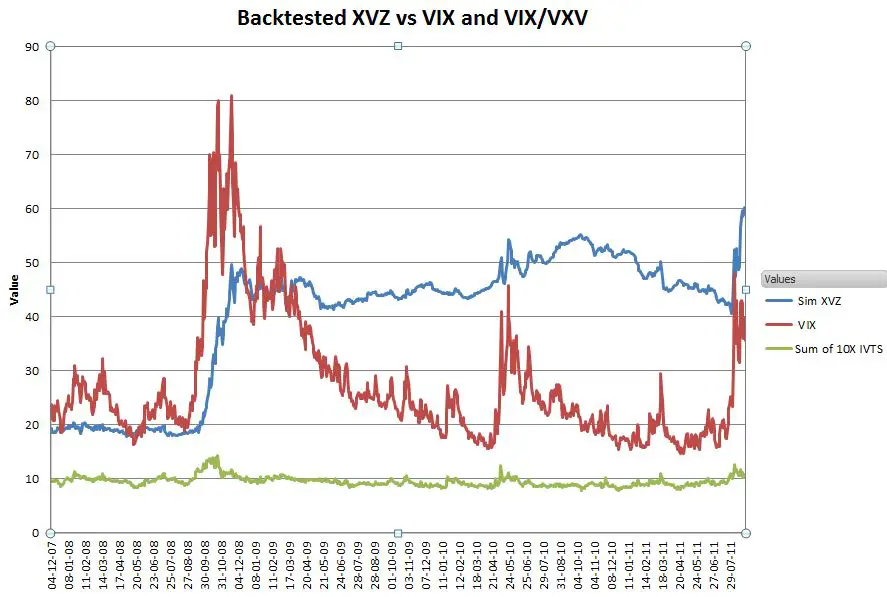
I’ve updated my XVZ backtest chart below, showing VIX and VIX/VIX3M multiplied by 10. XVZ is making big decisions based on -10% / + 15% moves in the VIX/VIX3M ratio.
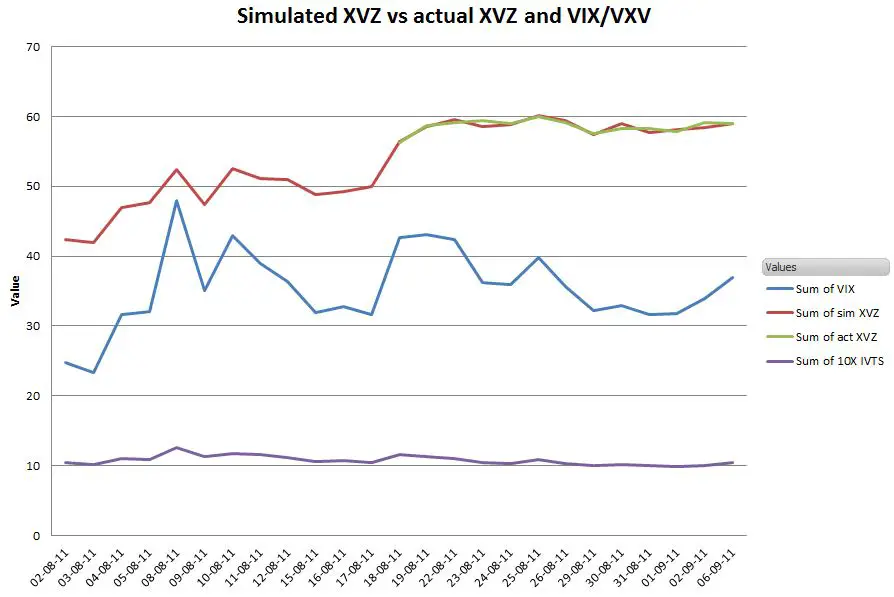
The graph below shows my simulated XVZ (red) vs the actual XVZ (green) for August and September. Things are tracking nicely.
If you are interested in purchasing the XVZ backtest data, or the data plus the underlying indexes and formulas see this post.

Thanks for article. It looks to me like XVZ may be a useful hedge against market crashes but not the best long term strategy for seeking alpha. I’m wondering how just the short term portion of this strategy would have performed? I’m looking for a good indicator for when to reduce or reverse XIV in a buy & hold strategy.
A possible destabilizing mode is if a fund family has both an inverse fund like XIV and a double fund like TVIX. Then say volatility spikes. TVIX must then buy more vol futures to keep its double percentage tracking going, while at the same time XIV must reduce its short position to keep its inverse percentage tracking going. So to reduce its short position, XIV must also buy vol futures. The net result is that both funds reinforce the demand for more vol futures, which can then potentially send volatility futures up even further. My impression though is that these ETNs aren’t yet popular enough to distort the futures market in this way…
If these same conditions apply in the future then XVZ would be an excellent pair trade with XIV during quiet times… My only question is, how will all these ETNs mess with the VIX curve in the future? Could you start trading VIX futures and arbitrage the distortions caused by these products?
Hi Maciek,
I have also wondered if these ETNs could be distorting the volatility futures. I think there are two factors that are mitigating this: 1. The rise of inverse funds (mostly XIV $540M assets) that would tend to counter balance out the demand that VXX creates ($945M assets), and 2: fund families within themselves cancelling out the providers risk so that they don’t have to hedge as much. For example Credit Suisse AG (the company that backs the VelocityShares products) has $99M assets in their 2X long TVIX–it seems like this would offset almost half the XIV risk. For an ETN the provider doesn’t have to actually enter into the market, they just have to guarantee the notes, so if their risk is hedged they can just park the rest of the cash where they want.
— Vance